PYQ (2019): Explain how the foundations of the modern world were laid by the American and French Revolutions.
THE BIG PICTURE
| Long ago, America wasn’t a country. It was 13 colonies (small territories) that belonged to Britain. Britain had just fought the Seven Years’ War against France, partly to protect American colonies from French expansion, which left Britain deeply in debt. Britain’s thinking was that since they had spent all this money defending the American colonies, so the colonies should help pay for it. So Britain started passing new tax laws (like the Sugar Act, Stamp Act, and Tea Act) taxing everyday goods like sugar, paper, and tea. The problem wasn’t just the taxes themselves, it was that the colonists had no representatives in the British Parliament to argue against them, which is why “No taxation without representation” became their rallying cry. This led to the Boston Tea Party (1773), wherein a group of colonists snuck onto British ships and dumped all the tea into water, as a protest. Britain retaliated with harsher laws, and so the war began. Colonists chose George Washington as their leader. In 1776, the colonies boldly declared that they wanted something more than fair treatment – complete independence from Britain. On July 4, 1776, they signed the Declaration of Independence, written mainly by Thomas Jefferson. July 4th is celebrated as America’s independence day. The war was tough: the colonists faced hunger, cold winters, and repeated losses, until France stepped in to help with soldiers and supplies. The turning point came at the Battle of Yorktown in 1781, where the British army surrendered. In 1783, the Treaty of Paris officially ended the war, and Britain recognized America as a free, independent nation – leading to the formation of the United States of America. |
INTRODUCTION
- 1765-1783
- 1st successful colonial revolt of 13 colonies against a European Empire, leading to birth of USA founded on Enlightenment ideals of liberty, constitutionalism, and popular sovereignty.
CAUSES
- Economic
- Post-1763 war debt: British incurred heavy debt from the Seven Years’ War and imposed a series of arbitrary taxes on colonies to recover costs:
- Sugar Act (1764)
- Stamp Act (1765): direct tax on printed materials; first direct tax, sparked huge backlash.
- Townshend Acts (1767): taxed glass, paper, tea, etc.
- Tea Act (1773): triggered the Boston Tea Party.
- Mercantilist trade policies: Colonies were restricted to trading mainly with Britain, limiting economic growth and profit.
- Restriction on westward expansion: Proclamation of 1763 blocked settlement beyond the Appalachians, angering land speculators and farmers seeking new land.
- Post-1763 war debt: British incurred heavy debt from the Seven Years’ War and imposed a series of arbitrary taxes on colonies to recover costs:
- Ideological:
- Enlightenment philosophy: Influence of John Locke (Natural Rights/Social Contract), Montesquieu (Separation of Powers) and ideas such as social contract, and government deriving power from consent of the governed.
- James Otis slogan: “No Taxation Without Representation” – as colonies had no representation in the British Parliament.
- Thomas Paine’s Common Sense spread revolutionary ideas widely
- Republicanism: Growing belief in self-governance and rejection of hereditary monarchy/tyranny.
- Socio-Political:
- Punitive measures after the Boston Tea Party: closed Boston Harbor, curtailed Massachusetts’ self-government united colonies in shared resentment.
- Quartering Act: Forced colonists to house British soldiers, seen as infringement on personal liberty.
- Lack of representation in British Parliament: deepening the sense of political exclusion.
KEY CHARACTERISTICS OF THE 13 COLONIES
Divided into 3 main regions:
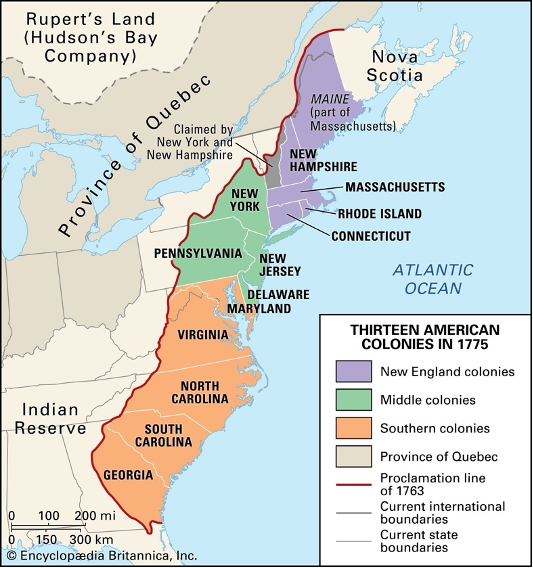
- New England: Massachusetts, New Hampshire, Rhode Island, Connecticut
- Rocky, glaciated soil in New England (leftover from the Ice Age) meant farming was hard, hence colonists were pushed toward the sea, hence they became master shipbuilders and traders.
- Middle Colonies: New York, New Jersey, Pennsylvania, Delaware
- Fertile alluvial soil in the Middle Colonies (similar to how river plains work in India, e.g., Indo-Gangetic plains) = naturally became a grain-producing belt. They were known as the “Breadbasket Colonies”– grew wheat, corn, and grain crops.
- Southern colonies: Virginia, Maryland, North Carolina, South Carolina, Georgia
- Warm, humid Southern climate = ideal for cash crops like cotton and tobacco, just like how climate determines cropping patterns in India (e.g., cotton in Deccan Plateau’s black soil regions).
- Heavy slave-labour reliance.
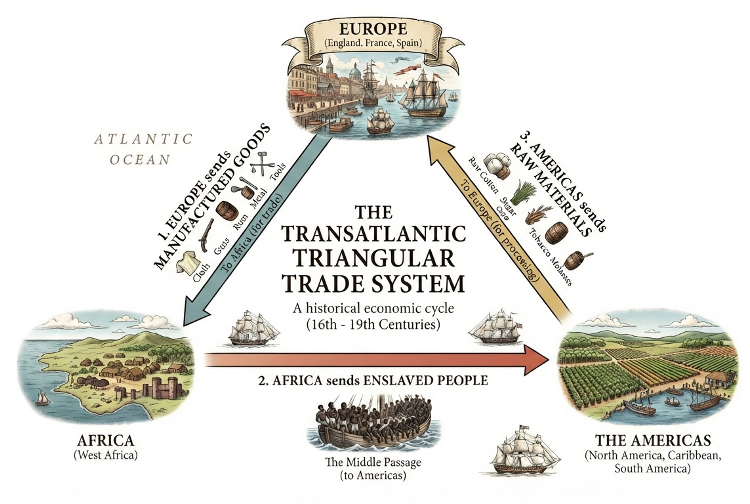
| 🔗 Connect this to GS-1: Notice how geography literally decided economic destiny and social institutions (like slavery). This is an example of environmental determinism. Why the South chose slavery: – Since the climate and soil suited labour-intensive cash crops (cotton, tobacco, rice, indigo), slavery became economically efficient. – The North avoided slavery because the colder, rockier geography didn’t suit large-scale plantations. Hence, labour needs were smaller-scale and didn’t require mass forced labour to be profitable. – The invention of Cotton Gin (1793) massively increased cotton processing speed, turning South the world’s largest cotton exporter by mid 1800s. – Ironically, this increased the demand for slaves as more land was cleared for cotton, and more labour was required to plant and pick it. – Raw cotton was exported to Britain (Manchester, Lancashire) when Britain was going through its own Industrial Revolution. British factories turned raw cotton into finished goods using new machines like spinning jenny and power loom. – Finished textiles were sold globally, including into colonial markets like India – which devastated India’s traditional handloom textile industry (deindustrialization). The Global Trade Triangle (Full Circle) between Europe, America and Africa financed Britain’s Industrial Revolution. And the diverging Northern and Southern economies within the US eventually became a root cause of the American Civil War. (See image below) 🔗 Connect this to GS-3 (Economy): Notice how colonies unknowingly followed a regional division of labour- – New England: services / trade – Middle colonies: primary produce (grains) – South: cash crops for export This mirrors modern debates on regional economic disparity in India– coastal states industrializing faster (like Gujarat, Tamil Nadu) vs agrarian heartland states. |
CHRONOLOGY OF EVENTS
- 1763: Seven Years’ War ends: leaving Britain deeply in debt
- 1765: Stamp Act passed.
- 1770: Boston Massacre: British soldiers kill 5 colonists during a protest.
- 1773: Boston Tea Party: Colonists dump British tea into Boston Harbor to protest the Tea Act.
- 1774: 1st Continental Congress: 12 of 13 colonies unified in Philadelphia; organized total economic boycott of British goods.
- 1775: 2nd Continental Congress: George Washington is chosen to lead the Continental Army.
- 1776 (July 4): Declaration of Independence signed: codified unalienable rights to Life, Liberty, and the Pursuit of Happiness. Inspired by Thomas Paine’s pamphlet Common Sense. Colonies officially declare they are a free, independent nation – the United States of America.
- 1777: Battle of Saratoga: Major military victory for colonists. France entered war as American ally.
- 1781: Siege of Yorktown: Joint American-French forces led by Washington and Lafayette defeated British General Cornwallis.
- 1783: Treaty of Paris signed: Britain officially recognizes American independence. War formally ends.
WHY COLONISTS WON?
- Asymmetric warfare advantage: Knowledge of rugged terrain, guerrilla tactics
- Geopolitical intervention: French, Spanish, Dutch reinforcements
- Strategic miscalculations by Britain: failed to rally domestic Loyalist base.
IMPACT (PYQ)
Political impact:
- World’s 1st modern democratic republic: Rejected hereditary monarchy entirely, replacing it with a government based on popular sovereignty (radical idea at the time when most of the world was ruled by kings and emperors)
- U.S. Constitution (1787): Introduced key democratic innovations such as federalism, institutional checks and balances, Bill of Rights.
| 📌 This was the first time a colony successfully broke from a European empire and built a written constitutional republic from scratch, a model later followed by Latin American independence movements. |
Economic Impact:
- Dismantling of restrictive British mercantilism: Colonies were earlier restricted to trading only with Britain. Independence allowed free global trade and the rise of private enterprise capitalism – merchants and entrepreneurs could now trade with any nation.
- Early Industrialization: With British imports cut off during the war, Americans had no choice but to manufacture goods locally. This laid the groundwork for the American Industrial Revolution in the early 1800s.
| 📌 This is an early real-world case of import substitution industrialization (ISI) – a concept later used deliberately by developing nations (including India post-1947) to build domestic industry. |
Social impact:
- Slavery persisted despite revolutionary ideals: Despite rhetoric of universal liberty, slavery remained constitutionally protected in the South to preserve economic stability. This led to the future U.S. Civil War + 13th Amendment abolishing slavery.
- Marginalization of Native Americans who allied with Britain
- Incomplete Gender Equity: Revolutionary rhetoric about “liberty and equality” did not extend to women, they were denied voting rights which took around a century to address (19th amendment to achieve women’s suffrage was passed in 1920).
Global strategic realignments:
- Provided the direct intellectual template for the French Revolution (1789)
- British imperial pivot eastward: Having lost its most valuable colonies in America, Britain redirected its imperial ambitions toward Asia and Africa — intensifying focus on India (East India Company’s expansion) and later Africa during the “Scramble for Africa” in the 19th century.
IMPACT ON INDIA
- Indian nationalism: The American Revolution’s ideas of liberty and self-rule inspired the French Revolution (1789), whose ideals of liberty-equality-fraternity later influenced Indian nationalist thinkers. Raja Rammohan Roy and later INC leaders drew on Enlightenment political vocabulary that traces back to this chain.
- Federalism template: The US Constitution’s federal structure (dividing power between states and center) was directly studied by India’s Constituent Assembly. Dr. Ambedkar and others borrowed the concept of judicial review and a written constitution from the American model, while adapting it India chose a stronger center learning from America’s own struggles with states’ rights (which nearly caused the Civil War).
- Fundamental Rights: The American Bill of Rights (1791) is a direct ancestor of India’s Fundamental Rights (Part III), both aim to limit state power over the individual.
- Checks and Balances: America’s system of separated powers influenced global constitutional thinking, including India’s judiciary developing the Basic Structure Doctrine (Kesavananda Bharati case) as its own version of constitutional “checks” against parliamentary overreach.
- Import substitution industrialisation: America’s forced self-sufficiency during the war mirrors India’s own ISI policy post-1947 (License Raj era), before liberalization in 1991.
WAS IT AN ECONOMIC REVOLUTION?
The American Revolution is often remembered as a political revolution (transition from monarchy to republicanism). But scholars debate whether it also qualifies as an economic revolution, given its fiscal origins and consequences.
YES (Arguments supporting an Economic Revolution):
- Rooted in fiscal grievances: Heavy Taxation by Britain to recover war debt.
- Independence overthrew mercantilism: This opened the path to free trade and private capitalist enterprise.
- Limited class realignment: confiscation and redistribution of wealthy British Loyalist lands -> created a new domestic economic elite.
NO: (Arguments supporting Political / ideological focus)
- Core issue was not the quantum of tax, but the authority to tax. It was a fight over political representation and sovereignty.
- No large-scale redistribution of wealth or land across social classes: Unlike France (which abolished feudal privileges) or Russia (which seized aristocratic and industrial property for the state). The existing elite (wealthy merchants, landowners, planters) remained firmly in power after independence. Political power simply transferred from a British-appointed elite to a domestic one.
- Left fundamental economic systems untouched: most notably the agrarian slave plantation complex of the American South.
The American Revolution can be best described as an “economic-trigger, political-outcome” revolution: economic grievances ignited it, but its primary achievement was political: sovereignty, republicanism, and constitutional government.
CONCLUSION
While the American Revolution left its profound promises of human equality unfulfilled for marginalized demographics, it fundamentally shattered the divine-right legitimacy of global absolute monarchies and provided the structural blueprint for modern constitutional democracy.
| 🔗 Connect with GS-4 (Ethics): The Declaration of Independence proclaimed “all men are created equal”, yet simultaneously preserved slavery. This shows cognitive dissonance between stated values and actual practice, and selective morality. Thomas Jefferson, who wrote “all men are created equal” literally owned over 600 slaves. This shows value contradiction in leadership. 🔗 Essay ideas: The Cotton Gin Butterfly Effect: One small invention in America in 1793 helped shape India’s colonial economic subjugation by the 1800s. Invention of Cotton gin ‣ makes cotton wildly profitable ‣ increases demand for slaves in the South ‣ fuels British Industrial Revolution (raw cotton supply) ‣ British textile dominance destroys Indian handloom industry ‣ contributes to India’s deindustrialization under colonial rule ‣ becomes a foundational grievance in Indian economic nationalism (Dadabhai Naoroji’s “Drain of Wealth” theory). 📌 Can be used in themes such as – ✓ Technology and its unintended consequences ✓ Interconnectedness of the world / globalization ✓ Ethics of progress / development at what cost? ✓ Cause and effect in history |
QUICK KEY-WORD REVISION
| Introduction: 1st successful colonial revolt against European empire, birth of USA Causes: ✓ Economic: Post-war debt • mercantilist trade policies • Proclamation of 1763 ✓ Ideological: John Locke • Montesquieu • No taxation without representation • Thomas Paine’s Common Sense • republicanism. ✓ Socio-political: punitive measures • Massachusett’s self govt • Lack of representation in British Parliament Important Events: End of 7 years’s war ‣ Stamp Act ‣ Boston massacre ‣ Boston Tea Party ‣ Declaration of Independence (Thomas Paine’s Common Sense) ‣ Battle of Saratoga (French entry) ‣ Battle of Yorktown (British defeated) ‣ Treaty of Paris Why colonists won: asymmetric warfare, French intervention, strategic miscalculations by British Impact: ✓ Political: 1st modern democratic republic • US Constitution (Bill of rights) ✓ Economic: Dismantling of British mercantilism • import substitution industrialization ✓ Social: Slavery • marginalization of allies of Britain • gender inequality ✓ Global: French revolution • British focus on India and Africa ✓ Impact on India: Nationalism (RR Mohan Roy) • federalism (adapted) • Fundamental Rights • Checks and balances (Basic structure doctrine) • import substitution industrialization (License Raj era) Conclusion: structural blueprint for modern constitutional democracy |
PRACTICE QUESTIONS
- “The Seven Years’ War laid the financial and strategic foundations for the American War of Independence.” Critically analyze. (15 Marks, 250 words)
- To what extent did the outcome of the American Revolution alter the geopolitical and colonial strategies of the British Empire in the East, particularly regarding India? (10 Marks, 150 words)
- Evaluate the structural and ideological contradictions of the American Revolution with special reference to the institutions of slavery and the status of women. (15 Marks, 250 words)
No responses yet