THE BIG PICTURE
| From its founding, the US carried a deep contradiction: a republic built on liberty that still allowed slavery to exist, especially across the Southern states. For decades, political compromises like the Missouri Compromise (1820) and the Compromise of 1850 tried to manage this tension rather than resolve it, but the divide only deepened as the North industrialized and grew morally opposed to slavery, while the South’s agricultural economy depended on it. This balance eventually collapsed in 1850s: “Bleeding Kansas” saw actual violence between pro- and anti-slavery settlers. This was followed by a Supreme Court Judgement (Dred Scott v. Stanford) wherein the Court ruled that enslaved people were not citizens and Congress couldn’t ban slavery in territories. The final trigger came in 1860 with the election of Abraham Lincoln, who opposed slavery’s expansion into new territories. Southern states saw this as proof the North would never respect their interests again, and rather than accept it, South Carolina and ten other states seceded to form the Confederacy. So we had the war between: 1. The Union: US Federal government under Lincoln, made up of Northern states that stayed loyal 2. The Confederacy: the 11 Southern states that seceded and formed their separate country – the Confederate States of America. It was commanded overall by Robert E. Lee. Lincoln’s war to preserve the Union soon turned into a war against slavery itself. The war reached its end when Robert E. Lee surrendered at Appomattox in April 1865, and just days later, Lincoln was assassinated, dying before he could see through the peace he had fought to secure. After the war settled, the Union was declared indivisible, and slavery was abolished through the 13th Amendment, followed by the 14th and 15th Amendments granting citizenship and voting rights to formerly enslaved people. But formal equality on paper didn’t translate into equality in practice. Southern states soon imposed Jim Crow laws, segregation, and voter suppression that rolled back much of what the war had promised, meaning the deeper struggle for genuine racial equality would stretch on for another century through the Civil Rights Movement and beyond. |
INTRODUCTION
It was an existential constitutional and military conflict between the industrialized Union and the agrarian Confederacy, triggered by the structural friction over slavery.
CAUSES
Economic Divergence Between North and South
- North: Industrializing economy (factories, railroads, wage labour; favoured protective tariffs to shield industry)
- South: Agrarian economy dependent on cash crops, and reliant on slave labour for profitability
- This divergence fed directly into the North’s growing moral and economic opposition to slavery, especially its expansion into new Western territories.
- Underlying this was a deeper constitutional disagreement: the South saw states as sovereign entities with the right to self-govern, preserve slavery, and even secede, while the North (under Lincoln) held the Union as indivisible and federal authority as supreme
Failure of Political Compromises
- Missouri Compromise (1820): drew a line across the map and said slavery couldn’t expand north of a certain latitude in new territories. In 1854, Kansas and Nebraska, both north of that line, needed to be organized as territories, so slavery there should have stayed banned.
- Kansas-Nebraska Act (1854): Instead of applying the Missouri Compromise, the Kansas-Nebraska Act let settlers themselves vote on whether to allow slavery in their territory. This turned Kansas into a race, with settlers from both North and South rushing there to rig the outcome in their favour, leading to real violence termed as “Bleeding Kansas”
Judicial trigger:
- Dred Scott v. Sandford (1857): Supreme Court ruled enslaved people were not citizens and Congress couldn’t ban slavery in territories
Immediate Political Trigger: Election of 1860
- Abraham Lincoln’s election, on a platform opposing slavery’s expansion (not immediate abolition), was seen by the South as proof the North would dominate national politics permanently.
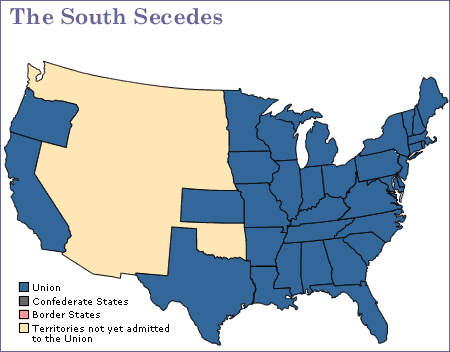
- Led directly to secession of South Caroline, followed by 10 more states forming the Confederate States of America.
| 🔗 Connect with GS-4 (Ethics): Lincoln’s evolving war aims, from simply “preserving the Union” to actively ending slavery, shows moral courage and leadership adapting under pressure. |
IMPACT
Constitutional and Political Impact
- Massive expansion of federal government power relative to the states, permanently altering the balance of American federalism.
- The Union was declared indivisible: no state could unilaterally secede
Abolition of Slavery
- 13th Amendment (1865): formally abolished slavery throughout the United States
- 14th Amendment: granted citizenship and equal protection under law to formerly enslaved people
- 15th Amendment: granted Black men the right to vote
- Legal foundation for equality was laid, even though social reality lagged far behind
Social impact:
- Post-war Reconstruction (1865–77) attempted to rebuild the South and integrate freed people into full citizenship
- Ultimately rolled back: Southern states imposed Jim Crow laws (segregation, voter suppression, and intimidation)
- Only nominal freedom to African Americans -> entered a century of systematic oppression via the “Reign of Terror”
- Genuine racial equality remained unrealized for another century, resolved only partially through the Civil Rights Movement of the 1950s–60s
Economic Impact
- Northern industrial boom: War accelerated industrialization, railroad expansion, and manufacturing – which made US an ascending global industrial titan
- Southern devastation: Devastated economy and infrastructure; plantation system collapsed, replaced gradually by sharecropping.
| 💡 South’s shift from slavery to sharecropping is a useful case study in how economic dependency can persist even after the legal institution creating it is abolished. ‣ After slavery was abolished, freed Black and poor white farmers had no land or money, while Southern landowners had land but no labour. ‣ Sharecropping bridged this gap: landowners provided plots of land in exchange for a large share of the crop (often 30% to 50%). ‣ Workers had to buy seeds, tools, and food on credit at high interest rates. ‣ At harvest time, their crop share rarely covered these debts, locking them into a continuous, generational cycle of debt that legally prevented them from leaving. ‣ Ending a legal injustice (like slavery in 1865) does not automatically end the underlying economic dependency. This system persisted for nearly a century until the Great Migration and mechanization broke it. Real social justice and emancipation require economic restructuring, not just a change in legal status. ‣ This mirrors India’s agrarian debt bondage systems (addressed by the Bonded Labour System Abolition Act, 1976), where legal freedom coexisted with economic trap-locks. |
Military and global impact
- Influenced later military thinking on total war and logistics, studied as a precursor to warfare seen in World War I.
- A unified, industrially strengthened United States emerged as a rising global power in the decades that followed, setting the stage for its 20th-century ascendancy.
| 🔗 Impact on India: ‣ The Cotton Crisis: When the American Civil War (1861–1865) blocked cotton exports from the US South, British textile mills suffered a severe shortage (“Cotton Famine“) and turned to India for supplies. ‣ The Cotton Boom: Cultivation surged across western India (especially the Deccan), transforming Bombay into a major global cotton trading hub and driving up exports. ‣ Rise of Indian Businesses: Local merchants (particularly Parsi and Gujarati traders in Bombay) made massive fortunes, which later funded India’s early textile mills and industrialization. ‣ Infrastructure Growth: Railways expanded quickly to connect cotton-growing regions to Bombay ports, though this development was designed purely for raw material extraction. ‣ Peasant Debt and Riots: When the war ended in 1865, global cotton prices collapsed. Farmers who had borrowed heavily to grow cotton could no longer repay their debts, leading to widespread economic distress and the Deccan Riots of 1875. A purely American internal war reshaped agrarian conditions in Maharashtra and became a cited cause of peasant unrest in colonial India, a striking global-to-local causal chain for any answer on colonial economic vulnerability. 🔗 Connect with GS-4 (Ethics): The gap between the war’s legal victory (13th–15th Amendments) and its social failure (Jim Crow, a century-long wait for real equality) is a powerful example of the difference between legal justice and substantive justice. Law alone doesn’t guarantee lived equality, directly mirroring India’s own experience with constitutional equality versus social reality (caste, gender, untouchability). The Civil War shows that ending an injustice legally and ending it socially are two separate battles. |
AMERICAN REVOLUTION VS. AMERICAN CIVIL WAR
| American Revolution | American Civil War | |
| Nature of conflict | War of independence: colonies vs. colonial power (Britain) | Civil war: internal conflict between two halves of the same nation (Union vs. Confederacy) |
| Core issue | Political self-rule; “no taxation without representation”; resistance to British imperial control | Slavery, its expansion, and the constitutional question of Union vs. states’ rights |
| Sides involved | 13 American colonies vs. Britain (with France, Spain, Netherlands aiding the colonies) | Northern states (Union) vs. Southern states (Confederacy) |
| Key leaders | George Washington (Continental Army), Thomas Jefferson, Benjamin Franklin | Abraham Lincoln (Union), Jefferson Davis (Confederacy); generals Grant (Union) and Lee (Confederacy) |
| Result | Colonies won independence; Treaty of Paris (1783) recognized the United States as a sovereign nation | Union preserved by force; Confederacy defeated and reabsorbed into the United States |
| Global context | Part of the broader Age of Revolutions; inspired later revolutions (French Revolution, Latin American independence movements) | Coincided with, and was shaped by, global industrial capitalism (e.g., triggered India’s cotton boom due to Britain’s supply disruption) |
The American Revolution was about a nation being born. The American Civil War, roughly 80 years later, was about that same nation nearly breaking apart from within, and being forcibly held together, testing whether the republic created in 1776 could actually survive its own internal contradictions, chiefly slavery.
CONCLUSION
Civil War resolved the foundational paradox of the American republic, establishing that a modern nation-centered federation could not permanently endure half-slave and half-free.
📌 QUICK KEY-WORD REVISION
| Introduction: constitutional conflict • industrialized Union vs. agrarian Confederacy • slavery Causes: ✓ Economic: industrialized north vs slave-dependent south • North’s opposition to slavery ✓ Failure of political compromise: Missouri compromise (no slavery beyond North) • Kansas-Nebraska Act • Bleeding Kansas ✓ Judicial trigger: Dred Scott v. Stanford ✓ Political trigger: Lincoln’s election • Secession of 11 Southern states Impact: ✓ Political: Union as indivisible (no secession) ✓ Amendments: 13th (abolition of slavery) • 14th (citizenship) • 15th (right to vote) ✓ Social: Failure of post-war reconstruction • nominal freedoms to African-Americans (reign of terror) • racial inequality continued ✓ Economic: North industrial boom • Southern devastation and shift to sharecropping ✓ Impact on India: Cotton crisis in Britain ‣ Shift to India for supplies ‣ Cotton boom in Deccan ‣ Rise of Indian businesses and infrastructure (railways) ‣ collapse of global cotton process post war ‣ Deccan Riots of 1875 Conclusion: resolved foundational paradox of American republic |
No responses yet