THE BIG PICTURE
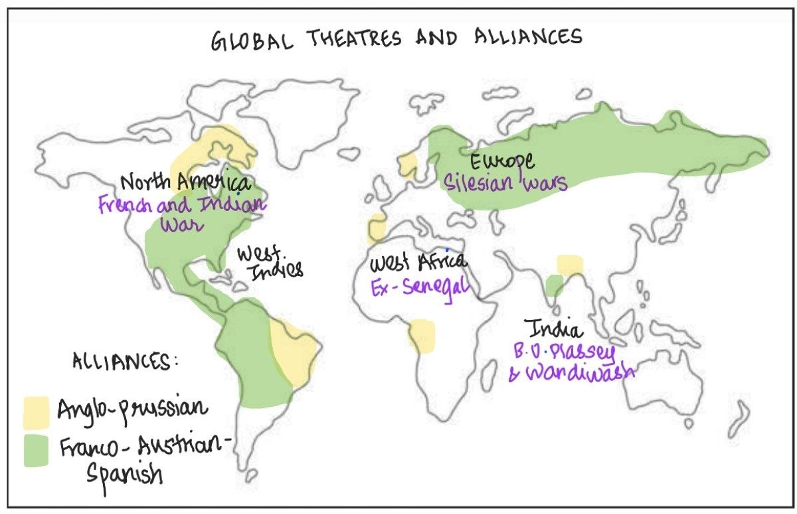
| Think of the Seven Years’ War as history’s first true global war fought over who would rule the world. It began as two separate conflicts in Europe: Prussia vs Austria (over Silesia), and Britain vs. France (for global trade supremacy). Britain and France were fighting over each other’s territories in North America’s Ohio River Valley, sugar islands in the Caribbean, and dominance in India – all of this was driven by a deeper mercantilist race for colonial markets and trade routes. In 1756, these two separate conflicts (Prussia vs. Austria, and France vs. Britain) fused into one war – the Diplomatic Revolution – wherein certain alliances reversed. Britain now allied with Prussia (breaking old alliance with Austria), and France now allied with Austria (were previously rivals). They then got involved in a global rivalry simultaneously in Europe, North America, the Caribbean, West Africa and India, which is why Winston Churchill later called it the first world war. It began in North America (over Ohio River Valley), then spread to Europe, and reached a turning point in India. British EIC seized control of Bengal’s revenues in Battle of Panipat, and then crushed the French for good in Battle of Wandiwash. Eventually, two treaties closed the war: the Treaty of Hubertusburg and the Treaty of Paris, post which French lost their positions in North America and India, and Britain emerged as the world’s dominant naval and colonial power. But that victory carried its own price: Britain fell under severe war debt, which it financed by imposing new taxes on its American colonies, leading to the future American Revolution and the birth of USA. Meanwhile, France’s humiliation and the huge cost of later backing the American Revolution pushed the French monarchy toward bankruptcy, leading to the French Revolution. |
INTRODUCTION
- Historian-statesman Winston Churchill famously called it “the first world war,” since it was the first conflict fought on a genuinely global, multi-continental scale.
- Twin, interlocking contests: a dynastic-territorial war in Europe (Prussia vs. Austria over Silesia) and a maritime-colonial war overseas (Britain vs. France for global trade supremacy).
CAUSES
Structural / long-term causes:
- Anglo-French rivalry: Over North America (Ohio River Valley), the Caribbean (sugar islands), and the Indian subcontinent.
- Austro-Prussian rivalry: Over Central Europe
- Mercantilist competition: Quest for trade supremacybetween French and Britain for access to colonial markets and maritime trade routes
- Industrial growth of Britain was a threat to French colonial interests
Diplomatic Revolution of 1756: reshaped alliances. Britain broke old ties to partner with Prussia, while France reversed centuries of rivalry to ally with Austria.
Regional triggers:
- North America: Britain colonies expanding into French territories
- Caribbean: competition over sugar plantations
- W. Africa: British attach on Senegal (French port) for gum
- India: Battles of Plassey and Wandiwash
MAJOR EVENTS
- 1754 – 63: Outbreak in North America: The conflict began as the French and Indian War over the control of the Ohio River Valley.
- 1756: Formal outbreak of war in Europe; Diplomatic Revolution realigns alliances
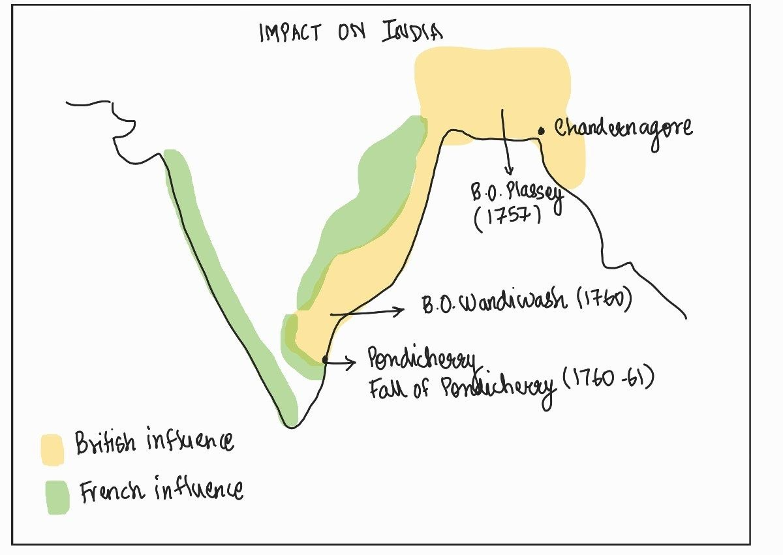
- 1757: Battle of Plassey: British East India Company gains control of Bengal’s revenues, giving it a decisive financial edge over the French in India
- 1756 – 63: The Third Carnatic War: The Indian theatre of the war between British and French forces for regional dominance.
- 1760: Battle of Wandiwash: British forces under Sir Eyre Coote defeated Count de Lally, effectively crippling French ambitions in India.
- 1763: Treaty of Paris: This landmark treaty officially settled colonial boundaries between France, Britain, and Spain, resulting in massive French territorial losses.
- 1763: Treaty of Hubertusburg: restored the pre-war status quo in Central Europe, confirming Prussian control over Silesia.
IMPACT
- On India:
- Plassey (1757) gave the EIC Bengal’s resources → Wandiwash (1760) eliminated the French threat → together these created the financial and strategic foundation for British territorial rule in India.
- cleared the path for the unchallenged expansion of British paramountcy in the subcontinent over the next century.
- North America: Britain emerged as the dominant colonial power on the continent but was left financially bankrupt by the massive costs of the war.
- Europe: The survival and rise of Prussia laid foundation for the future unification of Germany.
- Created the ‘First British Empire’ – world’s undisputed naval + colonial power
Domino effect: long-term revolutionary consequences-
- American Revolution (1775–83): Britain imposed new taxes (Stamp Act, Townshend Acts) on American colonies to recover war debt → colonial resentment → revolution.
- French Revolution (1789): Repeated wars against Britain, combined with the costs of supporting the American Revolution, pushed the French monarchy toward fiscal bankruptcy, a key structural cause of 1789.
WHY THE BRITISH WON
| Naval superiority | The Royal Navy blockaded French Atlantic ports, cutting off reinforcements and supplies to French colonies |
| Superior public finance | The Bank of England (est. 1694) and a mature system of public credit allowed Britain to sustain long-term war financing at low interest rates |
| Corporate structure of the EIC | The British East India Company was a privately managed, financially autonomous joint-stock company that could raise loans and act swiftly; the French Compagnie des Indes was state-controlled and bureaucratic, requiring approval from Paris for military funds — a delay of months |
| The “Bengal advantage” | Post-Plassey revenues from Bengal gave the British a self-financing war chest in India |
| Political stability | Continuity of leadership under William Pitt the Elder, who prioritized colonial/naval war over costly continental engagement |
CONCLUSION
- altered the global balance of power, transforming Britain from a maritime nation into the world’s apex colonial superpower financed by the wealth of Bengal.
- By redrawing the maps of three continents and triggering a domino effect of global revolutions like French and American
QUICK KEYWORD REVISION
| Intro: first global war • Winston Churchill’s phrase • multi-continental conflict Causes: Anglo-French colonial rivalry • Ohio River Valley • sugar islands • Austro-Prussian rivalry • mercantilism • Diplomatic Revolution of 1756 • Regional triggers Major events: Third Carnatic War • Battle of Plassey (1757) (Robert Clive • Siraj-ud-Daulah) Battle of Wandiwash (1760) (Sir Eyre Coote • Comte de Lally • fall of Pondicherry) • Treaty of Paris (1763) • Treaty of Hubertusburg (1763) Impact: French military power broken in India • British paramountcy • Prussia’s survival = foundation for German unification (1871) • First British Empire • Pax Britannica precursor Why Britain won: Royal Navy blockade • Bank of England (1694) = public credit system • British EIC (private, autonomous) • French Compagnie des Indes (state-controlled) • Bengal revenues post-Plassey • William Pitt the Elder Legacy / domino effect: American Revolution (1775–83) ( Stamp Act, Townshend Acts • war-debt taxation) • French Revolution (1789) (French fiscal bankruptcy • structural cause of 1789) |
PRACTICE QUESTIONS
“The Seven Years’ War was a turning point that shifted the scales of global power, ultimately laying the foundations for the British Empire in India and the seeds of revolution in America.” Critically analyse. (15 marks, 250 words)
No responses yet