THE BIG PICTURE
| After Rome fell in 476 CE, the last emperor named Romulus Augustulus wasn’t replaced by another emperor, and for a long time the region was now governed by a patchwork of Germanic kings (such as Frankish, Visigothic) rather than a single Roman-style emperor. Hence, Europe had neither central government nor money left in circulation. They turned to local strongmen for protection, and in return they pledged their loyalty and service. Since there was no cash to pay anyone, land became the payment instead. This created feudalism: kings gave land to nobles, nobles gave land to knights, and everyone owed service up the chain. To grow food on this land, farming estates called manors were owned by feudal lords / nobles and cultivated by peasants (who worked in exchange for protection). These peasants were sometimes tied to the land and provided unpaid labour (serfdom). Above all this was the Catholic Church which commanded monopoly over salvation, crowing of kings and a third of Europe’s land. These three things (feudal loyalty, manorial system, Church) kept Europe stable for a few centuries, even though ordinary people had little freedom. The system began breaking down in the 1300s. The Black Death killed 1/3 of Europe’s population, leaving less workers. This raised their bargaining power, weakening serfdom. The Church also began losing its credibility due to corruption and nepotism. On top of this, two big events shook things up further: 1. After Rome (Western Europe) fell, its contact with the Eastern Europe reduced significantly, and Western Europe became fairly isolated and busy with its own feudal and manorial life. Meanwhile, Eastern Europe was under the Byzantine Empire (capital: Constantinople). So when the Crusades (religious wars between Muslims and Christians) began, Western European Christians marched east to try to capture Jerusalem and the Holy Land, which were under Muslim rule at the time. Hence, Western Europe came into contact with the Islamic world and the Byzantine Empire – both of which were far more advanced in trade, science, and luxury goods than Western Europe was at the time. 2. In 1453, the Ottoman Empire (a Muslim Turkish empire) defeated the Byzantine Empire and captured Constantinople. The Ottomans started controlling several land routes, because of which Western Europeans started looking for alternative sea routes instead – kicking off the Age of Exploration. Since Constantinople was conquered by force, the Greek Orthodox Scholars living there fled to Italy, bringing with them centuries of classical Greek texts (Plato, Aristotle, and so on). This is one of the reasons why Renaissance took off in Italy specifically. All this pushed Europe out of the medieval world. Trade and banking (like the Medici family) replaced self-sufficient farming. Kings teamed up with merchants to build strong, centralized countries instead of relying on scattered nobles. And new ideas such as humanism, science, and eventually Martin Luther’s protest against the Church, replaced blind religious authority. |
INTRODUCTION
The medieval period spans around 1000 years, beginning from the fall of the Western Roman Empire (476 CE) to the beginning of Renaissance and Age of Exploration (late 15th C). It is divided into 3 phases:
- Early Middle Ages (5th – 10th C): AKA ‘Dark Ages’, political fragmentations and invasions.
- High Middle Ages (11th – 13th C): Feudalism matures, Crusades, population and trade growth.
- Late Middle Ages (14th – 15th C): Era of crisis – Black Death, 100 Years’ War, decline of feudalism.
3 Pillars defined this age:
- Feudalism: political-military organization of power
- Manorialism: economic organization of land and labour
- The Roman Catholic Church: spiritual, cultural and political authority
These three systems were mutually reinforcing: feudal lords derived legitimacy partly from the Church, manors were the economic base that sustained the feudal hierarchy, and the Church itself became a feudal landholder.
FEUDALISM (POLITICAL – MILITARY SYSTEM)
Definition: A decentralized system of governance based on reciprocal obligations: a lord granted fief (and protection) to a vassal in exchange for military service and loyalty.
Causes of the development of Feudalism:
- Collapse of Roman central authority: No empire-wide army, tax system, or law to maintain order
- Germanic successor kingdoms: Frankish, Visigothic, and other kingdoms lacked Rome’s administrative machinery
- Need for localized protection from Viking, Magyar, and Muslim raids
- Land as currency of power: Due to disruption of trade, land became the primary source of wealth and authority (instead of cash)
- Localized self-defence needs: Communities turned to nearby strongmen who could actually provide protection
Key mechanics and the feudal hierarchy: Decentralized governance based on land ownership and a pyramid of obligation.
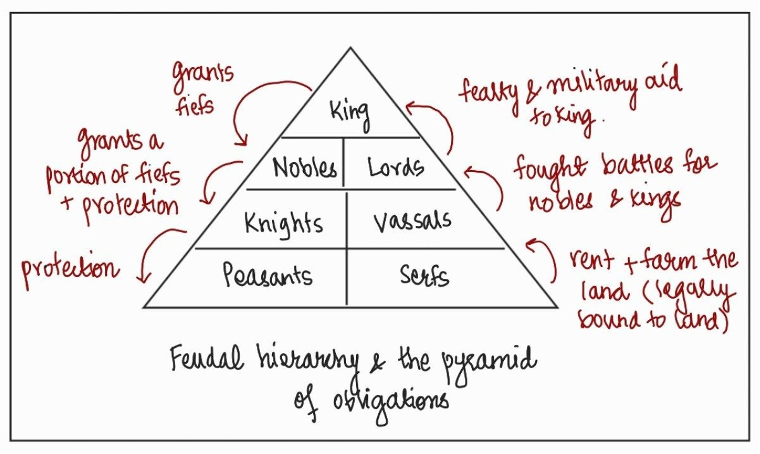
Impact of Feudalism:
| Positive | Negative |
| Political stability: Post fall of Western Roman Empire, feudal lords maintained law and order. Local Administration: Lords settled disputes, collected taxes and maintained infrastructure | Political Fragmentation: Europe was divided among powerful local lords, weakening central monarchies (e.g., France before Louis XI). |
| Protection: Lords protected peasants from Viking, Magyar and Muslim invasions in return for service. | Exploitation of Peasants: Serfs performed unpaid labour (corvée) on the lord’s demesne. |
| Stable Social Hierarchy: Clearly defined obligations between king, nobles, knights and peasants | Social Inequality: Birth determined status; peasants had few rights |
| Military Organization: Vassals provided trained knights to the king during wars | Rival feudal lords often fought private wars over land and succession. |
| Manorial system ensured continuous agricultural production and local self-sufficiency. | Economic Stagnation: Self-sufficient manors discouraged trade, urbanization and specialization. |
Value addition:
- Joseph Strayer: Feudalism provided political order during Europe’s age of insecurity.
- Karl Marx: Feudalism was a mode of production characterized by the exploitation of peasants by landowning elites.
| 🔗 Connect this to India: India also had a feudal-like structure under the later Mughal mansabdari– land granted in exchange for military service, very similar logic to European fiefs. |
MANORIALISM (ECONOMIC SYSTEM)
Definition: The Manorial System was the economic foundation of feudalism, based on self-sufficient agricultural estates (manors) owned by feudal lords and cultivated by peasants.
Structure:
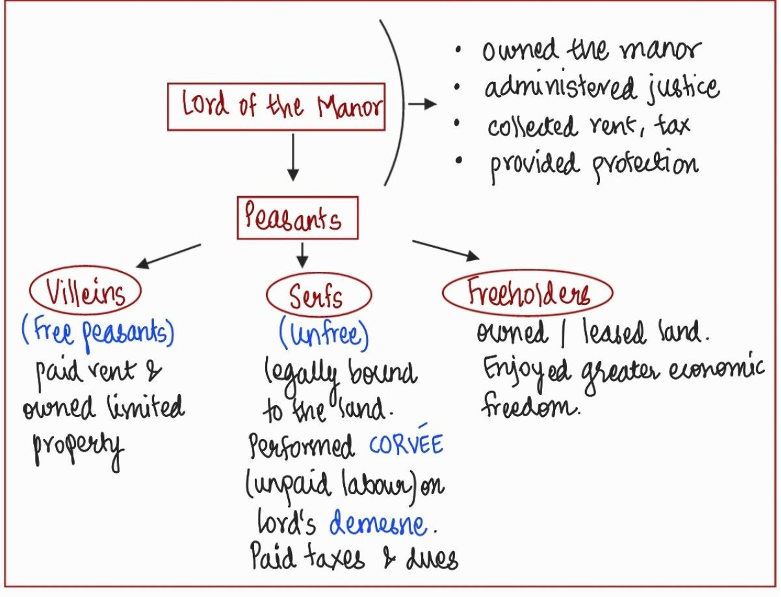
Key features:
- Subsistence Economy: The manor functioned as a self-sufficient economy, producing most goods required for local needs.
- Agricultural as the principal occupation: with the demesne (lord’s land) and peasant holdings forming the core of production.
- Limited Trade and specialization: as most goods were produced and consumed within the manor itself.
- Emphasis on local production for local consumption: making each manor largely independent of external markets.
- Lord’s Control: The lord exercised economic, judicial, and administrative control over the manor, including courts, taxation, and land management.
- Serfdom & Labour Obligations: Under serfdom, peasants paid rent through corvée (unpaid labour), agricultural produce, or, increasingly, money.
DOMINANCE OF THE ROMAN CATHOLIC CHURCH
The Church was the single most powerful and unifying institution in medieval Europe – often described as a “state within states,” commanding loyalty that transcended kingdoms.
Structure / Hierarchy:
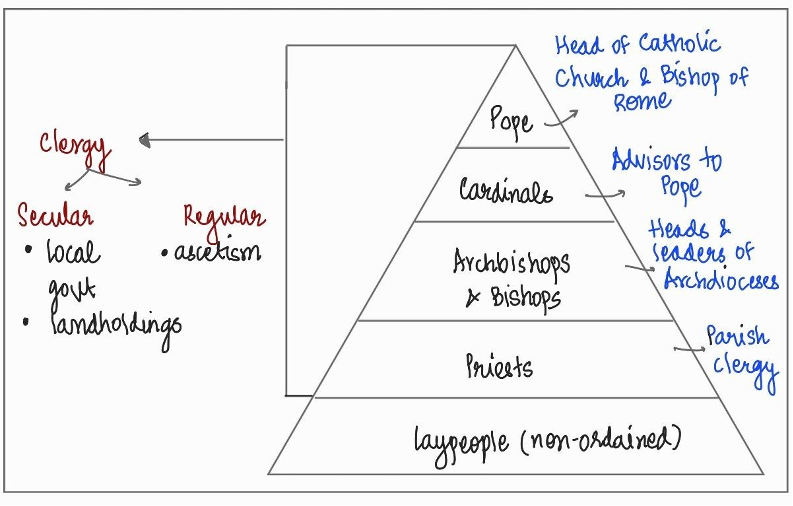
Powers of the Church:
- Religious: Monopoly over administration of the Seven Sacraments; claimed exclusive authority over salvation
- Political: Excommunication (expulsion of an individual from Church) and Interdict (suspension of sacraments in a region, to pressure defiant rulers like King John of England)
- Judicial: ‘Benefit of clergy’ – Clergy were tried under canon law in Church courts rather than royal courts
- Economic: Collected the tithe (a tenth of agricultural produce), accumulated roughly 1/3 of all land in Western Europe through grants and feudal fiefdoms.
Causes of the Decline of Church Authority:
- Simony: The sale of Church offices and positions for money
- Nepotism: Appointment of relatives to Church posts regardless of merit
- Corruption: Pope Alexander VI (Borgia) became a symbol of corruption.
- Avignon Papacy: Popes relocated to Avignon under French influence, seen as compromising the papacy’s independence
- Great Western Schism: Rival popes in Rome and Avignon simultaneously claimed legitimacy
- Suppression of inquiry: Galileo supported heliocentrism and was tried by the Inquisition
- Protestant Reformation: Rejection of Papal supremacy. Martin Luther (Germany), John Calvin (Switzerland), Henry VIII (England).
- Renaissance Humanism: Erasmus criticized corruption in Praise of Folly.
- Rise of wealthy merchant families like the Medici reduced dependence on the Church.
| 🔗 Connect with GS-2 (Polity): The Church’s fall from political power into subordination to the state (Peace of Augsburg’s “cuius regio, eius religio”) is the origin of secularism. You can contrast India’s positive secularism (equal respect for all religions) with the European model that emerged from this specific conflict (state supremacy over church). 🔗 Connect with GS-4 (Ethics): Galileo’s trial is a classic ethics reference point for conflict between scientific truth and institutional authority or courage of conviction vs conformity. |
TRANSITION FROM MEDIEVAL TO EARLY MODERN EUROPE
Major Catalysts:
- Crusades (11th – 13th c.): Reopened contact with the Byzantine and Islamic worlds; exposed Europe to Eastern luxury goods, learning, and trade networks.
- Fall of Constantinople (1453):
- Ottoman conquest severed old overland trade routes to Asia, pushing Europe toward sea routes (Age of Discovery)
- fleeing Greek scholars carried classical manuscripts to Italy, fueling the Renaissance.
- Black Death: Killed roughly 1/3 of Europe’s population; the resulting labour shortage raised peasant bargaining power, hastened the decline of serfdom, and destabilized the manorial economy.
Economic changes: From self-sufficient manors to a cash, trade-driven economy.
- Decline of manorialism -> Decline of serfdom.
- Age of discovery: Due to disruption of old land trade routes by the Crusades and the fall of Constantinople -> direct sea routes to Asia and the Americas
- Rise of banking and merchant capitalism: e.g., the Medici (Florence)
- Early capitalism: Profits were reinvested into trade and production rather than land. Ex- English and Dutch EIC.
Political changes: From feudal fragmentation to centralized states
- Revival of long-distance trade re-energized cities: Venice, Genoa, Florence, Bruges
- Increased social mobility: As prosperous peasants and artisans moved into trade -> Growth of a prosperous middle class (bourgeoisie).
- centralized nation-states: As Kings allied with this rising merchant class bypassing dependence on feudal nobles
- Political evolution: Absolute Monarchies (e.g., France under Louis XIV) → later Constitutional States (e.g., England after the 1688 Glorious Revolution)
Intellectual changes: From theology-bound scholarship to human-centred inquiry.
- Fall of Constantinople brought Greek scholars and classical texts to Italy — a direct spark for the Renaissance
- Printing Press (Gutenberg) -> spread of new ideas
- Rise of Humanism: focus on human potential, classical learning, and secular subjects (Petrarch, Erasmus)
- Scientific Revolution: Copernicus (heliocentrism) and Galileo (observational astronomy) directly contradicted Church-endorsed cosmology
- These currents matured into the Enlightenment.
Religious changes: From unified Catholic authority to religious plurality and state control
- Martin Luther’s 95 Theses (1517) publicly challenged practices like the sale of indulgences
- Triggered the Protestant Reformation, splintering Western Christianity into Catholic and Protestant camps
- Religious wars across Europe: Ex- Thirty Years’ War
- Peace of Augsburg: established the principle “Cuius regio, eius religio” – the ruler’s religion determined the state’s official religion
- Gradual subordination of Church authority to the State, laying groundwork for the modern secular nation-state
CONCLUSION:
This transition laid the direct foundations for the modern world: industrial revolution, democratic revolution, secularism and the age of Science and Enlightenment.
QUICK KEY-WORD REVISION:
| Feudalism: decentralized governance, reciprocal obligations, lord, fief, vassal, military service, loyalty, Roman collapse, localized protection, Viking / Magyar / Muslim raids, land-based economy, feudal hierarchy, pyramid of obligations, Serfdom / Corvee, Strayer (political order), Marx (Mode of production, exploitation) Manorial system: economic foundation of feudalism, self-sufficient agricultural estates, manors, Lord of the Manor, Villeins, Serfs (corvée, demesne), Freeholders, subsistence economy, agriculture, limited trade, local production and consumption, serfdom Roman Catholic Church: Pope, Secular Clergy, Regular Clergy (Monasticism), Seven Sacraments, Excommunication, Interdict, Canon Law, Tithe, Simony, Nepotism, Avignon Papacy, Great Western Schism Transition to Early Modern Europe: Crusades, Fall of Constantinople (1453), Black Death, Age of Discovery, Early Capitalism, Rise of Bourgeoisie, Nation-State, Centralization, Humanism, Printing Press, Renaissance, Enlightenment, Reformation, Cuius regio eius religio, Secularization |
PRACTICE QUESTIONS:
- To what extent did the economic, political, and religious transformations of the 14th–17th centuries in Europe lay the groundwork for the Industrial Revolution and the Age of Enlightenment?
- Compare the causes of feudalism’s rise with the causes of its decline. What does this comparison reveal about the nature of historical change?
No responses yet