PYQ (2025): The French Revolution has enduring relevance to the contemporary world. Explain.
PYQ (2019): Explain how the foundations of the modern world were laid by the American and French Revolutions.
THE BIG PICTURE
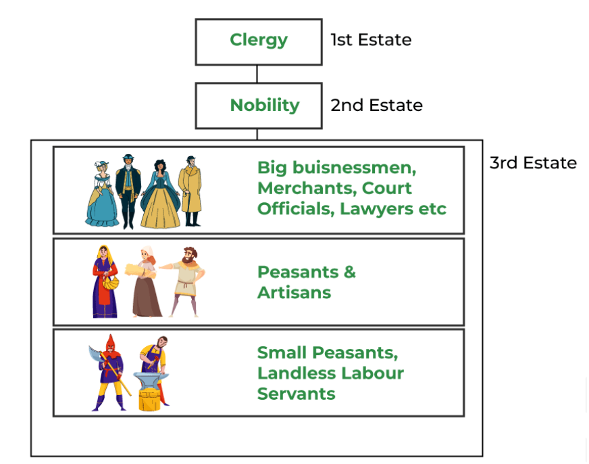
| Before the revolution started, France was in trouble. The king, Louis XVI, had spent too much money, partly from helping America in its war for independence, and the country was deeply in debt. At the same time, ordinary people were struggling with high taxes and rising bread prices, while the nobles and church leaders paid almost no taxes at all. French society was divided into three groups called “estates“: the clergy, the nobility, and everyone else (which was most of the population). This third group had no real power even though they made up the vast majority of the people. Anger over this unfairness grew, and when the king called a meeting of these three groups in 1789 to solve the money crisis, the common people’s representatives broke away and declared themselves the true government of France, forming the National Assembly. Tensions kept rising, and on July 14, 1789, an angry crowd in Paris stormed the Bastille, a prison that symbolized royal power. This event is seen as the start of the revolution and is still celebrated today as France’s national holiday. Soon after, the National Assembly abolished many noble privileges and wrote the “Declaration of the Rights of Man and of the Citizen,” which said all men were born free and equal. Over the next few years, the monarchy lost more and more power. In 1792, France became a republic, and in 1793, King Louis XVI was executed by guillotine, shocking the rest of Europe. The revolution then entered a violent phase called the Reign of Terror, led by Maximilien Robespierre, where thousands of people suspected of opposing the revolution were executed. This period ended when Robespierre himself was overthrown and killed in 1794. France remained unstable for several more years until a young military general named Napoleon Bonaparte rose to power and eventually took control of the government in 1799, ending the revolution. Even though it was messy and violent, the French Revolution introduced powerful new ideas, like liberty, equality, and the rights of citizens, which influenced many other countries and are still important values today. |
INTRODUCTION
It was a watershed socio-political upheaval that dismantled the feudal absolute monarchy of the Ancien Régime and institutionalized the universal concepts of liberty, equality, and popular sovereignty.
CAUSES
Intellectual – The Enlightenment gave revolutionaries their vocabulary and legitimacy
- Montesquieu (Spirit of the Laws): advocated separation of powers to prevent despotism.
- Rousseau (Social Contract): Popular sovereignty provided the theoretical basis for republicanism.
- Voltaire: Relentless critique of Church privilege and dogma.
Social – The Ancien Régime and the Estates System
- The Third Estate (commoners comprising ~97% of the population) bore almost entire tax burden with no political privilege despite economic weight.
- Peasants’ burdens: paid the taille (land tax), gabelle (salt tax), corvee (forced labour), tithe to Church, and feudal dues to landlords.
- Bourgeoisie’s grievances: Wealthy merchants, lawyers, and financiers had economic power but no commensurate social status or political voice. Hence, they provided leadership to the movement.
Political – Crisis of Absolutism
- Divine Right Monarchy: Louis XVI claimed authority from God, unaccountable to any representative body.
- Marie Antoinette’s (The Queen) perceived extravagance (“Madame Déficit“) fuelled public anger.
- American Revolution (1776–83): France’s support for American independence was ideologically inspiring but financially ruinous.
Economic – Fiscal bankruptcy and agrarian crisis
- State bankruptcy: By 1789, debt servicing consumed roughly half the royal budget; wars (Seven Years’ War, American War of Independence) had drained the treasury.
- Regressive taxation: Tax exemptions for clergy and nobility meant the burden fell disproportionately on those least able to pay.
- Agricultural crisis: Poor harvests caused bread prices to spike sharply, hitting the urban and rural poor hardest.
Immediate Causes
- The Financial Crisis & Meeting (1789): King Louis XVI ran out of money and called the Estates-General for the first time in 175 years to raise taxes.
- The Voting Fight: The Third Estate wanted individual votes. The nobility and clergy wanted one collective vote per class to always outvote the commoners two-to-one.
- The Tennis Court Oath: Locked out by the king, commoners gathered on a tennis court and declared themselves the National Assembly.
- Storming of the Bastille: Fearing a royal attack, Parisians attacked the Bastille prison for weapons, sparking the French Revolution.
IMPORTANT EVENTS
Constitutional Monarchy Phase (1789–1791)
- Tennis Court Oath: The Third Estate defied the king and declared itself the National Assembly.
- Storming of the Bastille: symbolizing the violent collapse of royal tyranny and absolute monarchy.
- Abolition of Feudalism & adoption of the Declaration of the Rights of Man and of the Citizen: Feudal privileges were dismantled, and a foundational document was adopted to enshrine the core Enlightenment ideals of liberty, equality, and popular sovereignty.
- Civil Constitution of the Clergy (1790): The revolutionary government radically subordinated the Catholic Church to the French State.
Radicalization & Wartime Crisis
- King’s failed flight to Varennes: King Louis XVI attempted to escape France in disguise, which utterly destroyed monarchical credibility and branded him a traitor in the eyes of the public.
- Rise of competing political factions: Power struggles intensified between the moderate Girondins, and the radical Jacobins, who were fiercely militant and led by Maximilien Robespierre.
The Jacobin Republic & Reign of Terror
- Execution of King Louis XVI and Marie Antoinette: Both monarchs were publicly tried and executed by guillotine, sealing the permanent death of the old regime.
- Mass executions: An estimated 17,000 people were executed by guillotine during a state-sponsored purge of suspected counter-revolutionaries and political dissidents.
- Thermidorian Reaction (1794): Fearing for their own survival, members of the National Convention turned against Robespierre, leading to his execution and bringing an abrupt end to the Reign of Terror.
The Directory & Military Ascension
- Oligarchic 5-member Directory: Following the chaos of the Terror, executive power was handed to a five-man Directory that proved to be highly corrupt, weak, and politically unstable.
- Napoleon Bonaparte: Exploiting the ongoing political chaos and weakness of the government, Napoleon Bonaparte overthrew the Directory in a coup, establishing a new era of military-backed rule.
| 🔗 Connect with GS-4 (Ethics): Robespierre’s justification that extreme violence (terror) was not just a tool, but an absolute necessity to protect and enforce revolutionary morality (virtue) is a example in the “ends vs. means” debate. When a leader or a regime becomes convinced they possess a monopoly on absolute truth and moral righteousness, compromise becomes impossible. Anyone who disagrees is no longer viewed merely as a political opponent with a different view, but as an existential threat or moral traitor who must be eradicated. This mindset transforms the machinery of the state into an instrument of ideological purification, directly breeding state-sponsored violence and mass purges. |
IMPACT
Political and Social Impact
- Constitutionalism & Core Ideals: Popularised the written Constitution and the ideals of liberty, equality, and fraternity, which profoundly shaped the Indian Constitution.
- Popular Sovereignty & Global Unrest: Established the principle of popular sovereignty, which inspired modern revolutions across Asia, Africa, and contemporary movements like the Arab Spring.
- The Napoleonic Code: Introduced uniform taxation and equality before the law, which heavily influenced legal systems across Europe and Latin America.
- The Reign of Terror: Served as a historical warning against unchecked radicalism, highlighting the importance of Judicial Review and Separation of Powers.
- Global Republicanism: Elevated republicanism from a radical experiment into a viable global norm.
Social Dimensions & Rights
- Secularism (Laïcité): Enforced a rigid separation between the Church and the state in France, setting a precedent for strict political secularism.
- Women’s Rights & Activism: The initial exclusion of women from rights declarations triggered resistance like the Women’s March to Versailles.
- Mass Political Participation: Brought common citizens directly into the political sphere.
Economic Transformation & Land Reforms
- Land Redistribution & Post-Colonial Reforms: The confiscation and redistribution of feudal and clerical lands to small peasant proprietors created economic mobility, serving as a blueprint for post-colonial land reforms, such as those in post-independent India.
- Rise of the Bourgeoisie & Capitalism: Fueled the rise of the merchant middle class, laying the structural groundwork for modern industrial capitalism.
- Uniform Taxation: Abolished chaotic feudal tax anomalies in favor of a rationalized, uniform tax burden.
- Universal Human Rights: Provided core philosophical frameworks that later influenced the UN Universal Declaration of Human Rights.
Global Spread of Nationalism & Geopolitics
- Mass Conscription (“Nation in Arms”): Invented the concept of Levée en Masse, introducing total war and mass citizen conscription into modern statecraft.
- Geopolitical Realignment: Shifted strategic pressures, influencing British colonial focus and imperial policies toward regions like India and Africa.
| 🔗 Impact on India: Constitutional & Ideological Influence ‣ Democratic Framework- The ideals of liberty, equality, and fraternity shaped the Indian Constitution’s Preamble and Fundamental Rights. ‣ Rule of Law & Equality- The principle of equality before the law inspired modern Indian jurisprudence and challenged traditional hierarchies. ‣ Secularism: France’s aggressive secularism (Laïcité – rigid separation and state control over public religious display) provides the ultimate contrast to India’s Sarva Dharma Sambhava (principled distance and equal respect for all religions). Socio-Economic & Land Reforms ‣ Blueprint for Land Reforms- The redistribution of feudal lands served as a structural blueprint for post-independent India’s Zamindari Abolition and Land Ceiling Acts. ‣ Social Justice- The dismantling of rigid privileges influenced modern Indian aspirations for social leveling and mobility. Geopolitical & Strategic Repercussions ‣ Impact on Indian Rulers- Rulers like Tipu Sultan were fascinated by the revolution, planting a “Tree of Liberty” and joining the Jacobin Club. ‣ British Imperial Shift- The French threat compelled the British East India Company to aggressively expand and consolidate its territory in India. |
AMERICAN VS. FRENCH REVOLUTION
| American Revolution | French Revolution |
| Cause: Primarily a colonial anti-taxation and independence movement against British imperial rule. | A profound internal social, political, and economic upheaval aimed at destroying the Ancien Régime, absolute monarchy, and entrenched feudal privileges from within. |
| Ideological foundations: John Locke’s social contract theory, and the protection of natural rights (life, liberty, and property). | Enlightenment philosophies (Rousseau, Voltaire), focusing on universal concepts of Liberty, Equality, Fraternity and the total restructuring of society. |
| Radicalism and violence: Characterized by a war of secession. | Escalated into extreme radicalism, marked by the Reign of Terror, mass public executions by guillotine, and the complete dismantling of the Catholic Church’s traditional state power. |
| Outcome: Resulted in the birth of the United States, creating the world’s first modern constitutional republic. | Led to the abolition of feudalism, the rise of modern nationalism, the Napoleonic Code. |
| Legacy: inspired future federalist and anti-colonial movements. | served as the ideological blueprint for modern European left-wing politics, land reforms, and global democratic revolutions. |
RISE OF NAPOLEON BONAPARTE
| When the French Revolution exploded in 1789, it tore down France’s absolute monarchy and old feudal system, plunging the country into a decade of chaos, economic ruin, political corruption, and violent purges like the Reign of Terror. Into this vacuum stepped Napoleon Bonaparte, an ambitious young military officer from the island of Corsica. Using his brilliant tactical skills, he won stunning victories in foreign wars that made him a national hero. Seizing the moment when the public grew exhausted by the weak and corrupt ruling government (the Directory), Napoleon overthrew it in a 1799 coup and eventually crowned himself Emperor. Rather than restoring the old tyranny, he stabilized France by combining revolutionary ideals with centralized control – creating the Napoleonic Code, establishing the national bank, and opening government jobs to talent rather than noble birth. However, his relentless drive to conquer Europe ultimately overextended his empire, sparking resistance movements that led to his final defeat and exile, permanently altering the map of the modern world. |
Domestic reforms:
- Napoleonic Code (1804): Established equality before the law, religious freedom, private property rights, and permanently abolished birthrights and aristocratic privileges.
- Fiscal Reconstruction: Founded the Bank of France, stabilized the national currency, introduced uniform taxation, and applied protective tariffs.
- Meritocracy: Replaced old systems with state-sponsored meritocracy, ensuring skilled and capable people ran the civil service.
- Infrastructure: Invested heavily in public works and capital expenditure.
Global Impact:
- European Redrawing: Dissolved the ancient Holy Roman Empire, grouped German lands into the Confederation of the Rhine, and set up client states like the Kingdom of Italy.
- Spurring Counter-Nationalism: French military occupation bred deep anti-French sentiment, ironically sparking local nationalisms that later fueled the unification of Germany, the Italian Risorgimento, and Spanish liberation.
- Modern Borders: Laid the structural groundwork for Europe’s modern nation-state system.
CONCLUSION
The French Revolution was the crucible that forged modern political vocabulary. By permanently destroying the divine right of kings and replacing subjects with citizens, it established the foundational framework for democratic governance, secularism, and human rights globally.
📌 QUICK KEY-WORD REVISION
| Introduction: dismantled the feudal absolute monarchy of the Ancien Régime • liberty, equality, and popular sovereignty Causes: ✓ Intellectual: Montesquieu’s separation of powers • Rousseau’s social contract • Voltaire’s critique of the Church ✓ Social: Tax burden on the Third Estate • Taille, gabelle, corvee, tithe • Bourgeoisie’s lack of political and social status ✓ Political: Divine Right Monarchy (Louis XVI) • Marie Antoinette’s extravagance ✓ Economic: Bankruptcy due to wars • Regressive taxation • Rising bread prices ✓ Immediate: 1st meeting of the Estates • Voting dispute • Tennis Court Oath • Storming of the Bastille Impact: ✓ Political: Constitutionalism and ideals of liberty, equality, fraternity • popular sovereignty and contemporary movements (Arab Spring) • The Napoleonic Code • The Reign of Terror inspiring JR and SOP • Global republicanism ✓ Social: secularism (Laïcité) • Triggered Women’s March to Versailles • Mass political participation ✓ Economic: Land redistribution to small peasants • Rise of the Bourgeoisie & Capitalism • Uniform Taxation • Universal Human Rights influencing UNDHR ✓ Global spread of nationalism: Mass Conscription (“Nation in Arms”) , Levée en Masse, total war • Shift of British focus to India ✓ Impact on India: Constitutional (liberty, equality, fraternity, rule of law, contrast with secularism) • land reforms • Tipu Sultan (Tree of Liberty, Jacobins Club) • British focus on India Conclusion: established the foundational framework for democratic governance, secularism, and human rights |
No responses yet